What information is available?
Signals from inside your body, outside your body, your relationships, your environment, and your current state.
The practice of self-directed evolution
Every day, your body senses, interprets, acts, and adapts. What happens repeatedly becomes part of the person who enters the next moment.
Bioplasticity is a live practice for learning how to participate more deliberately in that process.
$99/month · live every week · join anytime · there is no week one
The first realization
Your body does not wait for you to announce that you are ready to change. It is learning all day.
What you pay attention to. What you ignore. How you breathe. How you move. What you repeat. What you avoid. What you expect. The environments you spend time in. The people you spend time around.
All of it becomes part of the conditions shaping what comes next.
You are going to adapt anyway. Bioplasticity asks what happens when you learn to participate.
A little history
These are people talking about earlier versions of my coaching work, before I had the word Bioplasticity for the larger map.
You’ll see TheTongue.com throughout this video. That was the name of my coaching practice when these conversations were recorded.
A working definition
These processes overlap constantly. Action changes what you sense. Interpretation changes what feels available to do. Adaptation changes the organism that enters the next moment.
Signals from inside your body, outside your body, your relationships, your environment, and your current state.
Attention, prediction, memory, context, expectation, and meaning all participate in what the signal becomes for you.
Movement, breath, speech, attention, approach, avoidance, play, habit, and changes you make to the environment around you.
What becomes easier, harder, more sensitive, more automatic, more familiar, or newly available because of what keeps happening.
Every adaptation changes the self that enters the next moment.
A familiar doorway
Neuroplasticity describes the nervous system’s capacity to change with experience.
Bioplasticity zooms the lens out. The nervous system lives inside a body that senses, moves, predicts, recovers, learns, relates, and acts in an environment.
Neural change is part of the story. So are sensory learning, motor learning, attention, conditioning, habit, sleep, recovery, social experience, and the repeated actions through which a person becomes more practiced at being a particular version of themselves.
Bioplasticity is the practice of participating in that change.
What we actually train
Perception is an aggregate. Many streams of information are being sampled, combined, weighted, and interpreted at the same time.
Vision, hearing, smell, taste, touch, pressure, vibration, surface temperature, and the sensory texture of the environment.
Interoception includes signals related to heartbeat, breathing, visceral state, hunger, fullness, internal temperature, effort, and other homeostatic conditions.
Proprioception, vestibular information, balance, orientation, body schema, force, load, and the felt experience of movement.
Attention, prediction, memory, state, timing, social cues, prior learning, and current goals shape what incoming signals mean to you.
More resolution gives you more information. More information gives you more possible moves.
Signal, percept, meaning
A lot of human experience gets collapsed into enormous categories: “I feel bad.” “I’m stressed.” “I’m tired.” “My body hurts.” “I can’t focus.” “I don’t feel like myself.”
Inside each of those experiences may be many distinguishable signals. Breath. Pressure. Heat. effort. body position. movement. heartbeat. balance. vision. sound. fatigue. expectation. attention. memory. social context. fear. anticipation.
Something is happening.
Your system organizes what it senses.
You make sense of what the experience means here and now.
Those steps can happen so quickly that they feel like one event. Training helps us notice more of what happened between them.
“He didn't fix anything. He just made it impossible to keep pretending I didn't already know.”
Anonymous client
Active sensing
Your eyes move. Your head turns. You shift your weight. You reach, sniff, listen, touch, move closer, step away, change posture, change breathing, ask a question, and alter the environment.
Every action changes the information available next.
Acting is also a way of sensing.
The curriculum architecture
Bioplasticity has a map underneath it: seventy-two primary teaching entrances grouped into nine constellations. Each node can be explored on its own, through its subnodes, or as part of a route connecting several parts of the map.
They connect because your body does the same thing. Breath affects state. State affects attention. Attention affects what you perceive. What you perceive affects interpretation. Interpretation changes action. Action changes the next thing you sense.
There is no week one. You can join whenever you find us.
One route through the map. The full current registry is below.
Each node can open into subnodes and be explored through different training lenses such as detection, discrimination, resolution, calibration, flexibility, tolerance, range, and recovery. The same node can lead somewhere different each time we return to it.
“No deadline or rule. My choice.”
a writer, in fellowship
The live program
One week may enter through breath. Another through pain, balance, play, attention, sleep, movement, social perception, or something somebody in the group is actively living through.
Those are routes through the same map.
Every week
I choose a node, explain the principle, and connect it to the larger system.
You may pay attention differently, change how you breathe, move, listen, stand, compare sensations, play with timing, or test an assumption.
Questions, observations, coaching, things that did not work, things somebody noticed for the first time, and connections to other parts of the map.
This is where 25-plus years of coaching experience becomes useful.
“Real live research in the moment.”
a writer, in fellowship
Why the group matters
Give ten people the same perceptual experiment and you may get ten different reports.
Someone notices breathing first. Someone notices pressure in their feet. Someone notices vision narrowing. Someone notices emotion. Someone feels almost nothing.
That variation is useful. The room becomes a living perceptual laboratory. You learn from your own system while discovering how differently other systems can encounter the same experiment.
“This is fun. It is helping me to think differently and more clear.”
a writer, in fellowship
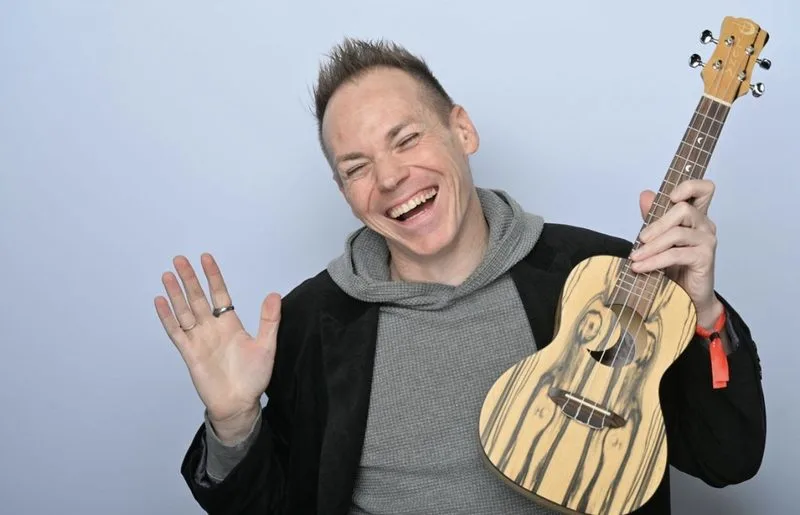
Why Ryan
How does a human being become more capable of participating in their own experience?
My work has moved through hypnosis, coaching, breath, attention, interoception, sound, voice, movement, physiology, play, performance, perception, and the strange ways people change when they begin noticing more.
Ryan Today is what Ryan Yesterday decided.
I took that name in 1999 as a thought experiment about becoming. Yesterday's decisions become part of today's reality. Today's choices shape the vantage point tomorrow inherits.
Bioplasticity is the container I finally have for that body of work.
Bioplasticity Live
A live weekly practice in self-directed evolution.
Stay for a month. Keep exploring as long as the room remains useful to you.
There is no week one
If you join while we are exploring proprioception, that is where you begin. If the following week takes us into prediction, you go there. Months later we may return to proprioception through movement, pain, balance, or attention and discover an entirely different layer.
The map accumulates. So do you.
Join BioplasticityQuestions
No. There is no required sequence in the live group. The system is happening all at once, so you can enter through whatever node the room is exploring when you arrive.
No. I use the vocabulary when it helps us make useful distinctions. The point is lived practice and better observation.
Members have access to the growing archive while they are in the group, so you can return to sessions you missed or revisit a node that matters to you.
No. Bioplasticity is education, experiential practice, and coaching. It does not diagnose or treat medical or mental health conditions. Bring clinical concerns to an appropriate licensed professional.
The live group is ongoing and open-entry. The map contains a large body of material, but we move through it according to the needs of the room and revisit important territory when it becomes useful.
One last thing
Your experiences will train something. Your habits will train something. Your attention will train something. Your actions will train something.
Tomorrow begins with the organism those repetitions helped create.
Begin with the person who showed up today.