You have systems running at the speed of light. Photon-level events inside your tissue, femtoseconds, trillionths of a second. Hydrogen bonds breaking and reforming in picoseconds. Cells making decisions on timescales of minutes. Fascia reorganizing over weeks.
You are a stack of clocks, all running at once, all coupled to each other. When those clocks are in sync, you feel it. That's the experience of flow. When they decouple, you feel that too: the disjointed, fractured experience of stress, anxiety, or dissociation.
The physics here is real. Your mitochondria operate on nanosecond timescales. Your neurons fire in milliseconds. Your heart beats in seconds. Your circadian rhythm runs on a 24-hour cycle. Your hormonal rhythms oscillate in ultradian waves of 90 to 120 minutes. Your fascia remodels over weeks and months. Each of these timescales is a real, measurable clock in your body, and they are all coupled.
A stack of clocks, all running at once. Just like you.
Flow is synchronization
When researchers study flow states, they find increased neural coherence, meaning multiple brain regions oscillating in phase. Heart rate variability shifts toward resonance frequencies. Muscle tension drops to the minimum needed for the task. Time perception changes because the clocks that normally create your sense of duration are temporarily aligned, running in sync rather than pulling against each other.
This is not mystical. It's the same physics that governs coupled oscillators in any system. Pendulum clocks on the same wall synchronize. Fireflies flash in unison. Hearts in the same room entrain to each other. Entrainment is a universal physical phenomenon, and your body is made of it.
Is the future even in front of you?
Most English speakers conceptualize time with the future "ahead" and the past "behind." But the Aymara people of the Andes do the opposite. For them, the past is in front (you can see it, you've lived it) and the future is behind (you can't see it, it hasn't happened yet).
This isn't just a linguistic curiosity. It reveals that our spatial experience of time is constructed, not given. Your body doesn't have a "future direction." It has rhythmic processes at multiple scales, and your brain assembles a narrative of temporal flow from those rhythms.
When you learn to sense those rhythms directly, through interoceptive attention to heartbeat, breath, and autonomic cycles, your relationship with time itself changes. Not because you've learned a trick, but because you've accessed the actual substrate of temporal experience.
Training temporal awareness
In the weekly group sessions, we work with time deliberately. Breath holds that make you aware of your own ultradian rhythm. Sound practices that entrain cardiac coherence. Music that shifts tempo and forces your system to either resist or synchronize. Balance challenges on The Pivot that compress proprioceptive processing into millisecond windows.
Experiential capacity grows through use, not through understanding alone. You can read about biological timescales, or you can feel your own stack of clocks start to align. The Six Inputs framework gives you the map. The practice gives you the experience.
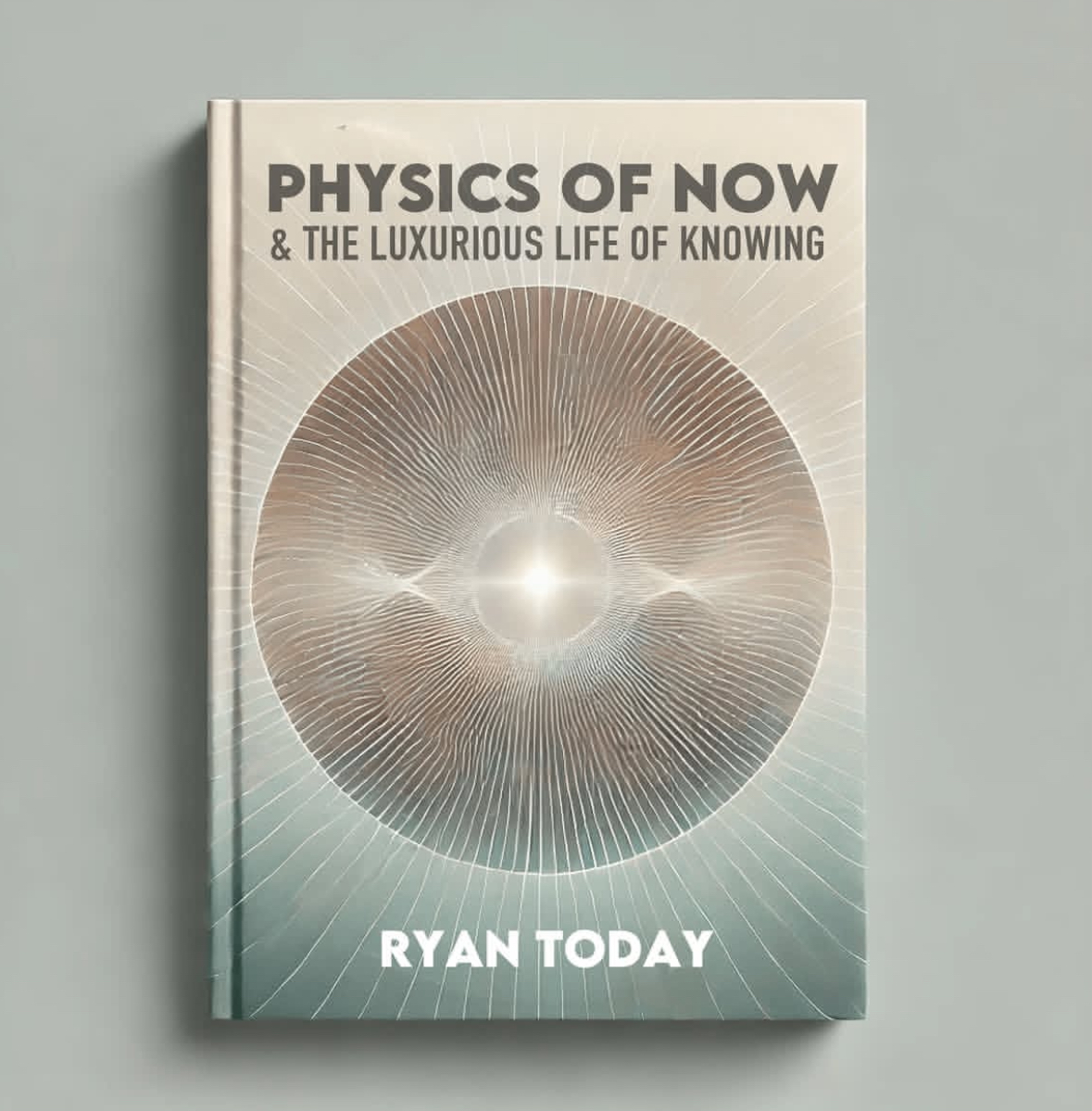
Physics of Now
& The Luxurious Life of Knowing. An earlier book exploring the physics of presence, time, and what your body already knows about both. Not published publicly. Available to members of my community.